
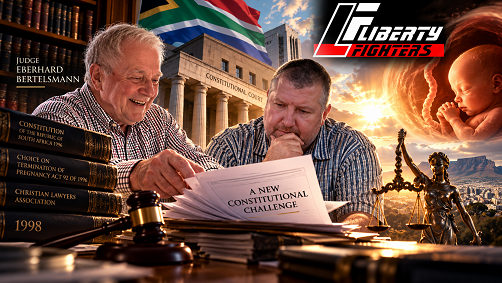
Excerpt: Before becoming a judge, Eberhard Bertelsmann SC stood as senior counsel in the 1998 constitutional challenge to South Africa’s abortion law. Almost three decades later, while terminally ill, he joined LFN in rethinking how that unfinished constitutional battle could return to court upon a stronger evidential and legal foundation. Following his passing, LFN reaffirms its commitment to pursue that challenge — and will dedicate it to the memory of the man who spent his final months helping us prepare to ask the questions he believed South African law had never fully answered.

If you like our work, why not consider a donation or gift of your choice?
or make a quick donation… MobiPaid
Some court cases end when judgment is handed down.
Others remain unfinished for decades.
For retired Judge Eberhard Bertelsmann, the constitutional challenge to South Africa’s abortion legislation appears to have been one of those unfinished cases.
I only learnt this week that Judge Bertelsmann had passed away. His death was announced during early August 2026 after he succumbed to cancer at the age of 79. Known in legal circles as “Rotweiler“, the South African Judiciary publicly mourned him as a jurist who had served for many years and remained involved in matters of public importance after his retirement.
The news hit me particularly hard.
Not merely because South Africa had lost an experienced jurist, but because Judge Bertelsmann and I had unfinished work together.
During the final months of his life, while he was already seriously ill with terminal brain cancer, we had begun discussing something which had followed him for almost three decades: whether the constitutional questions surrounding abortion in South Africa should return to court — but this time upon a fundamentally reconsidered legal foundation.
And he wanted to be part of it.
The case that began in 1998
This was not some academic interest of his.
Before Eberhard Bertelsmann became a judge, E Bertelsmann SC was senior counsel for the plaintiffs in Christian Lawyers Association of SA and Others v Minister of Health and Others 1998 (4) SA 1113 (T).
The proceedings challenged the constitutionality of the then-new Choice on Termination of Pregnancy Act, 1996 (Act No. 92 of 1996) on the basis, principally, that section 11 of the Constitution provides that “everyone has the right to life“, and that the protection should extend to human life before birth.
The case was heard on 12 May 1998 and judgment was delivered on 10 July 1998. Bertelsmann appeared for the Christian Lawyers Association and the other plaintiffs.
But there is an important feature of that history which should not be forgotten.
The case did not proceed to an ordinary trial in which competing scientific, medical, biological, philosophical and other evidence about the beginning and nature of human life was comprehensively tested.
The State excepted to the particulars of claim.
Indeed, counsel for the plaintiffs specifically argued that the issues should not be decided without evidence and that the exception was therefore inappropriate. The Court nevertheless determined the constitutional interpretation at that stage. It concluded that the word “everyone” in section 11 could not be interpreted as including a foetus for purposes of constitutional legal personality, upheld the exception and dismissed the claims.
That distinction matters.
The 1998 judgment settled a legal proposition at High Court level. It did not, however, amount to a scientific finding after a trial that biological human life does not begin at conception. Those are not identical questions.
Almost three decades later, that distinction became central to the conversations Judge Bertelsmann and I were having.
A conversation I never expected to become a farewell
A mutual friend informed Judge Bertelsmann that Liberty Fighters Network intended to investigate a fresh constitutional challenge concerning abortion.
His reaction surprised me.
Despite suffering from terminal brain cancer, he was keen to become involved.
There was no sense from him that the matter belonged to history. Quite the contrary. Our discussions conveyed to me that he had continued thinking about the old litigation and believed that, if the subject ever returned to court, it should not simply repeat the case that had been brought in 1998.
It should start again from the foundation.
During one of our private discussions, Judge Bertelsmann told me something which I have never forgotten.
He told me that, following the earlier case, he had been placed under pressure by senior peers not to proceed further with an appeal because persistence with the matter could adversely affect his prospects of being called to the Bench.
According to what he told me, he ultimately left the matter there.
He was appointed to the High Court Bench in 2000.
I make an important distinction here in fairness to everyone concerned: I am recording what Judge Bertelsmann personally told me. I was not present when any such pressure was allegedly exerted upon him, and I cannot independently establish what unnamed persons may or may not have said to him almost three decades ago.
But I know what he told me. He spoke with sincerity and, from the manner in which he shared this with me, I was left with the distinct impression that what had happened had weighed heavily upon him for many years. It appeared to me that, morally and religiously, and particularly in speaking to me as a fellow Christian, he felt compelled to disclose what had happened and why the case had been left where it was.
And the disclosure troubled me deeply.
It troubled me particularly because Bertelsmann himself had written about the importance of independence within the advocates’ profession. In 1998 he wrote that counsel must be capable of representing a client’s interests “without fear or favour“.
For someone who had spent a lifetime within our legal system, his account raised a profound question: what happens when legal practitioners dealing with constitutional questions of enormous moral and social consequence feel professional pressure about whether those questions should proceed through the appellate courts?
That question is larger than abortion.
It goes to the integrity of constitutional litigation itself.
Courts must ultimately decide cases upon the Constitution, law and properly admitted evidence. Careers, professional relationships, popularity, religious convictions, political expectations and institutional sensitivities cannot substitute for that process.
He wanted to start with one question
Judge Bertelsmann’s proposed approach was striking precisely because he did not suggest simply resurrecting the 1998 pleadings.
He wanted us to rethink the case.
His proposal was that proceedings should begin through an action founded upon a narrower and logically prior question: whether a court, upon a proper evidential foundation, can determine when individual human life begins.
He expressed the proposition simply:
Life begins at conception.
His view was that this question should first be properly ventilated before the courts upon the evidence and that its legal consequences should then be confronted.
That does not mean that a biological finding, by itself, automatically answers every constitutional question concerning abortion.
South Africa’s Constitution also expressly protects bodily and psychological integrity, including the right to make decisions concerning reproduction and the right to security in and control over one’s body.
Those constitutional rights cannot simply be wished away.
Neither, however, does identifying them answer every conceivable question about whether prenatal human life attracts some other form of constitutional or legal protection, whether the State may have duties towards such life, how competing interests should be reconciled, or at precisely what point the law should recognise those interests.
Those are questions for legal argument and evidence.
And that was precisely why Bertelsmann wanted to begin again.
The position of the father must also be confronted
There was another aspect of our discussions which was characteristically provocative from a legal perspective.
Judge Bertelsmann believed that the law should reconsider whether the biological father has any legally protectable interest in his unborn child.
The present statutory position is formidable. Section 5(2) of the Choice on Termination of Pregnancy Act expressly provides that, subject to limited exceptions elsewhere in the section, no consent other than that of the pregnant woman is required for termination of a pregnancy.
Bertelsmann discussed the paternal interest with me using concepts that extended even into the language of “possession”.
Any future pleading would, however, have to formulate that issue with considerable precision.
A man’s biological relationship with an unborn child cannot sensibly be translated into ownership of a woman’s body. Her bodily integrity remains constitutionally protected. The real legal question would be whether fatherhood gives rise to any independent protectable interest concerning the unborn child, distinct from ownership of or control over the pregnant woman, and, if so, what the constitutional limits of that interest would be.
That is a much harder question.
Hard questions are exactly what constitutional courts exist to answer.
Then came Dobbs
There is also a significant development which did not exist when the South African case was argued in 1998.
On 24 June 2022, the United States Supreme Court delivered judgment in Dobbs v Jackson Women’s Health Organization, overruling Roe v Wade and Planned Parenthood v Casey. The majority held that the United States Constitution does not itself confer a constitutional right to abortion.
That judgment does not determine South African law.
Our constitutional text is materially different. Section 12(2) expressly protects reproductive decision-making and bodily control, wording which has no direct equivalent in the United States Constitution.
But Dobbs nevertheless has comparative significance for another reason.
The 1998 South African judgment itself discussed Roe v Wade and foreign jurisprudence when considering the constitutional status of the foetus.
One of those major comparative constitutional authorities has since been overturned by the very court that created it.
That does not automatically overturn Christian Lawyers.
What it does demonstrate is that constitutional jurisprudence on abortion is neither intellectually frozen nor immune from reconsideration merely because a previous court has spoken.
Constitutional precedent develops.
Scientific knowledge develops.
Legal arguments develop.
And constitutional questions may return in materially different form.
An uncomfortable constitutional question deserves a proper answer
LFN’s contemplated proceedings will therefore not be based merely upon saying that the 1998 Court was “wrong”.
That would be far too simplistic.
The more meaningful enquiry is whether questions that were not fully tried in 1998 can now be properly pleaded, supported by expert evidence and placed before a court within today’s constitutional jurisprudence.
The Constitutional Court itself has subsequently recognised, in another prenatal context, that where the facts are complex and the law uncertain, an exception may be an inappropriate mechanism through which finally to resolve questions requiring development of the common law. In H v Fetal Assessment Centre, the Court stressed the importance of allowing difficult factual and constitutional questions to be properly developed rather than prematurely terminated where the record was insufficient. That case concerned a very different cause of action, and it does not decide the abortion issue, but its procedural reasoning is significant.
This time, if proceedings are instituted, the object should be to build the evidential foundation from the beginning.
What is a human organism?
When does a genetically distinct human organism begin to exist?
What does “everyone” mean for purposes of section 11?
Is legal personality the only means by which the Constitution can protect prenatal human life?
Does the State have any constitutional obligation towards developing human life even where full legal personality is absent?
How should any such interest be reconciled with a pregnant woman’s rights under sections 10, 12, 14 and 27?
Does a biological father possess any legally cognisable interest before birth?
And what effect, if any, should developments in comparative constitutional jurisprudence since 1998 have upon the reasoning adopted then?
Those questions deserve answers through law and evidence rather than slogans from either side of the abortion debate.
The man behind the robe
There is something deeply moving to me about the fact that Judge Bertelsmann wanted to engage with this subject again while knowing that his own life was approaching its end.
He did not have to.
He had already practised as senior counsel, served for more than 16 years on the Bench and retired in 2016. Even after retirement, reports following his death recorded that he remained active in legal work and provided assistance through a legal clinic associated with the Christian Lawyers Association.
He could easily have regarded the 1998 case as ancient history.
He did not.
As fellow Christians, our discussions naturally included our shared belief in the sanctity of human life. But what interested me most was that he did not propose replacing law with theology.
He wanted to go back to court.
He wanted evidence.
He wanted the question properly framed.
And he wanted the law to confront it.
We did not finish in time
That is the part which hurts.
Our family’s relocation to Cape Town, together with one public-interest case after another and particularly the enormous amount of work consumed by LFN’s Western Cape baboon litigation, repeatedly delayed my ability to return to this project with him.
I believed there would still be time.
There wasn’t.
I wish profoundly that we had finished what we started while he was still here.
But perhaps unfinished work does not always die with the person who began it.
Sometimes it becomes an obligation carried by those who remain.
LFN accordingly intends to continue investigating and developing the constitutional challenge we had begun discussing with Judge Bertelsmann.
It will not be his case.
He is no longer here to settle the pleadings, correct us when we go too far, challenge us when our reasoning is weak, or sharpen an argument with the experience accumulated over a lifetime at the Bar and on the Bench.
But his thinking will form part of its history.
And his insistence that the matter should be reconsidered upon a stronger foundation will not be forgotten.
In memory of Eberhard Bertelsmann
When this matter eventually returns to court, Liberty Fighters Network intends to dedicate the challenge to the memory of Judge Eberhard Bertelsmann.
Not because a former judge’s involvement predetermines the answer.
It does not.
Not because his religious convictions settle a constitutional question.
They do not.
But because, near the end of his life, a man who had stood as counsel in this very controversy in 1998 was prepared to return to the questions he believed had never been adequately resolved.
He was prepared to reconsider his own case.
He was prepared to rethink the strategy.
And despite terminal illness, he was prepared to work.
That deserves to be remembered.
We will remember him not merely as the judge he became, but also as the advocate who stood in court in 1998 for a case that remained on his conscience, and as the retired jurist who, almost three decades later, was willing to open the file again.
He did not live long enough to finish that final brief.
We intend to ensure that the questions he wanted asked are not buried with him.
May Judge Eberhard Bertelsmann rest in peace.
And may his unfinished work receive the careful constitutional hearing he hoped one day it would receive.
Liberation Greetings
If you like our work, why not consider a donation or gift of your choice?
or make a quick donation… MobiPaid


Leave a Comment
You must be logged in to post a comment.