
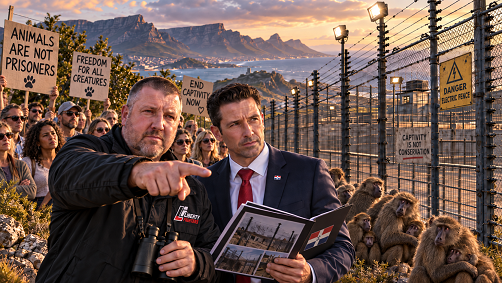
Excerpt: Chief Justice Mandisa Maya has requested a report from the Western Cape Judge President on the issues raised by LFN in the increasingly extraordinary baboon litigation. Meanwhile, public opposition to the proposed sanctuary is growing, CapExit leader Jack Miller has joined protesters on the ground, and the anticipated relocation date has passed without baboons observed inside the sanctuary. After months of delays, resistance and escalation, LFN’s message remains simple: keep moving forward.
Read the letters hereunder…

If you like our work, why not consider a donation or gift of your choice?
or make a quick donation… MobiPaid
There are times in a long legal battle when a small development changes the atmosphere completely. Not because the case has suddenly been won, and not because every obstacle has disappeared, but because after months of pushing against a seemingly immovable system, something finally shifts.
That happened to Liberty Fighters Network this past week.
On 11 September 2026, Chief Justice Mandisa Maya responded to our urgent request for intervention in the Western Cape baboon litigation. In her letter, she confirmed that she had requested Judge President Mabindla-Boqwana to provide her with a report on the issues raised by LFN, and that we would be informed of the outcome as soon as practicably possible.
For those who have followed this matter closely, the significance should not be underestimated.
The Chief Justice has not ruled in our favour. She has not made a finding against the Judge President, Holderness J or anybody else. We must be accurate about that. But equally, she did not dismiss what we placed before her as nothing more than the complaints of a disgruntled litigant. The head of South Africa’s judiciary has asked the head of the Western Cape Division for a report.
That means questions which, for months, appeared to be trapped inside the Western Cape judicial administration are now being looked at from above.
For LFN, that is progress.
And perhaps that is the most important lesson in this entire matter: keep moving forward.
The baboon case has never followed a straight road. We brought an urgent application because we believed irreversible measures were approaching. When that failed, we sought leave to appeal. When that process stalled, we pursued case-management intervention. When concerns about judicial conduct arose, we went to the Judicial Service Commission. When the internal judicial administration did not resolve the impasse, we escalated further.
Eventually, the matter landed on the desk of the Chief Justice.
None of those steps happened because the system made things easy for us. They happened because we refused to accept that silence, delay or procedural resistance should be the end of the road.
Meanwhile, outside the courtroom, the situation has also started changing.
On Sunday, another protest was held at the proposed baboon sanctuary. The difference from the previous week was immediately noticeable: many more people arrived. Concern is spreading, and more members of the public are beginning to ask questions for themselves instead of simply accepting that because a plan carries an official stamp it must necessarily be right.
Among those who came was Jack Miller, leader of the Cape Independence Party, CapExit.
That deserves mentioning because political support in this matter has been remarkably scarce. We have approached parties across the political spectrum. Most have preferred silence. CapExit did not.
Jack Miller came personally. He stood with the protesters, and afterwards he and I went through the sanctuary together to see the facility for ourselves.
His first reaction was blunt:
“Horrific!”
There was no political speech attached to it. No carefully prepared statement. It was the immediate response of someone seeing the sanctuary with his own eyes.
What was equally significant was what we did not see.
There were no baboons inside.
The information available to us had indicated that the relocation process was expected to commence on or about 12 September 2026. That date has now passed. We cannot responsibly tell the public that the relocation has been cancelled, because we have not been told that. What we can say is that the anticipated commencement did not appear to have taken place according to that timetable.
For now, at least, the baboons have not been moved into the sanctuary.
That matters enormously.
In litigation involving potentially irreversible action, delay usually works against the person seeking protection. Here, for once, a delay in implementation buys the baboons time. It gives the public more opportunity to scrutinise the sanctuary. It gives the SPCA’s position more room to be heard. It gives political leaders another opportunity to reconsider the wisdom of rushing ahead. Most importantly, it gives the judicial process more time to catch up with events outside court.
That does not mean we can relax. Quite the opposite.
The danger throughout this case has been that the practical reality will change before the courts finally decide whether it should have changed at all.
This is exactly why LFN approached the DA leadership before matters reached this point.
We did not ask the DA to concede our court case. We did not ask them to instruct Holderness J, interfere with the judiciary or dictate an outcome. We asked for something considerably simpler: use whatever lawful political and executive influence is available to pause irreversible implementation while the unresolved court processes run their course.
Frankly, even a cautious political response would have been enough to show that our concerns were being treated seriously.
Something as simple as:
“We cannot promise anything, but we have taken note of the concerns and will see what can lawfully be done.”
That would at least have demonstrated leadership.
Instead, the DA leadership chose not to engage substantively with us.
The matter was pushed back towards governmental structures and the familiar position that the case was before the courts and must take its course.
But that answer ignores the very problem we were raising.
The court process was not moving at the same speed as the implementation process.
That is the entire reason political restraint became relevant.
A government does not have to do something today merely because it might legally be permitted to do it eventually. There is a difference between possessing a power and being compelled to exercise that power immediately. Political and executive leadership can choose caution. It can preserve the status quo. It can say that, where a living environmental controversy is still before the courts, the responsible course is to wait.
Instead, the public has watched the legal process grind on while the implementation machinery continued moving.
And now some DA supporters have taken to our social-media platforms calling our reporting “Rubbish and fake news”.
That response says more than they probably realise.
If people truly believe our reporting is wrong, then challenge the facts. Ask whether baboons were in the sanctuary on Sunday. Ask whether the Chief Justice wrote to LFN. Ask whether she requested a report from the Judge President. Ask what the SPCA has said about permanent confinement. Ask whether the DA leadership was formally requested to intervene. Ask whether the leave-to-appeal process has been delayed.
Those are factual questions.
Calling something “fake news” because it is politically inconvenient does not answer any of them.
And this is perhaps one of the most disappointing features of modern politics: people become so emotionally invested in a political party that they begin defending the party before they have even asked what happened.
LFN is not anti-DA because we challenge DA-led institutions. We challenge the ANC, the DA, banks, regulators, courts and any other institution when we believe constitutional accountability requires it.
No political party is entitled to immunity from scrutiny simply because some of our supporters happen to vote for it.
The DA itself has built much of its national political identity around demanding accountability from the ANC. That is entirely legitimate. But the same standard must apply when the spotlight turns towards Cape Town and the Western Cape.
Constitutionalism that only works against your political opponent is not constitutionalism.
It is partisanship.
And this case has increasingly become a test of that distinction.
The irony is that the baboons themselves have become the vehicle through which all of these much larger issues have surfaced.
What started as a dispute over capture, relocation and sanctuary confinement has drawn attention to a constitutional Commissioner for the Environment who has never been operationalised, the legal foundation of a joint government task team, the accountability of the DA-led provincial and municipal structures, the treatment of self-represented public-interest litigants, the use of adverse judgments from unrelated cases, judicial conduct complaints, the role of the JSC, and now intervention by the Chief Justice at the level of judicial administration.
None of that was planned when we started.
One issue simply exposed another.
That is often how targeted litigation works.
You pull at one thread and suddenly discover how much of the fabric is connected.
This latest development should therefore be understood for what it is: not the end of the fight, but proof that persistence can move matters.
A week ago, supporters were watching protests outside a sanctuary.
Now the Chief Justice is waiting for a report from the Judge President.
Those two developments may appear unrelated, but they share the same cause: people refusing to accept that nothing can be done.
The public protested.
The SPCA spoke.
CapExit stepped forward.
LFN kept filing, writing, challenging and escalating.
And eventually the matter reached somebody who could ask the Judge President directly:
What is happening here?
That is movement.
But movement costs money.
I wish that were not necessary to say so often, but pretending otherwise would be dishonest.
On Friday we again asked our supporters to assist LFN financially. Since that call, only one supporter has made a donation.
We understand that times are difficult. Food costs more. Electricity costs more. Fuel costs more. Families are struggling. Many people who support our work simply do not have money to spare.
But LFN lives in exactly the same economy.
There is no separate economy for activists.
The difference is that while dealing with those same pressures, we are also carrying litigation and public-interest work which benefits people far beyond our own organisation.
Every court application requires time. Every bundle requires printing and preparation. Every trip costs money. Every hour spent answering affidavits, researching law, attending court, corresponding with institutions and helping members is an hour that cannot be spent generating ordinary income elsewhere.
The State has taxpayers.
Municipalities have ratepayers.
Banks have shareholders.
Large law firms have paying clients.
LFN has the people who believe its work should continue.
That is the reality.
I will not beg anybody for money.
But neither will I pretend that independent public-interest work can survive indefinitely on encouragement alone.
If you believe South Africa needs an organisation willing to challenge powerful institutions without first asking which political party they belong to, then that independence must be sustained somehow.
If you cannot contribute financially, there are other ways to help. Share the articles. Bring people to court. Attend protests. Read the documents. Challenge misinformation. Introduce somebody new to LFN.
But if you can afford to contribute, even modestly, understand what you are supporting.
You are not paying for a legal service.
You are helping keep an independent voice alive.
And independence matters most precisely when the institutions being challenged would prefer that voice to disappear.
This weekend reminded me why giving up is never an option.
At the sanctuary stood a growing group of ordinary people saying that they were not prepared simply to accept what was happening to the baboons.
Among them stood the leader of a political party willing to put his boots on the ground and see the place for himself.
And at the highest level of the judiciary, the Chief Justice had already asked the Western Cape Judge President to explain the issues LFN had raised.
None of those things existed when we started.
They exist now because we kept moving.
So that is what we will continue doing.
We await the report requested by the Chief Justice. We continue monitoring the sanctuary. We continue watching what happens to the baboons. We continue pursuing the Commissioner for the Environment. We continue the appellate and JSC processes. We continue asking questions that some would rather not answer.
And when the next obstacle appears, we will deal with that too.
Because liberty has never belonged to people who wait patiently for somebody else to defend it.
It belongs to those prepared to keep moving forward.
If you like our work, why not consider a donation or gift of your choice?
or make a quick donation… MobiPaid

Leave a Comment
You must be logged in to post a comment.