
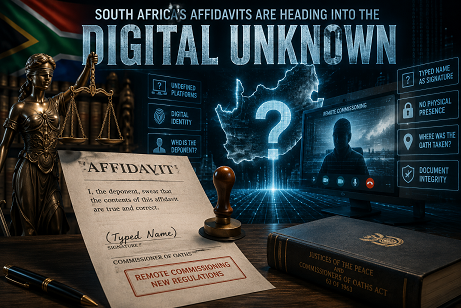
Excerpt: LFN has formally objected to South Africa’s proposed new oath and affirmation regulations — and what appears at first to be a routine legal update could fundamentally change the reliability of sworn evidence. Remote commissioning, pre-signed affidavits, typed names treated as signatures, undefined electronic platforms and inadequate identity safeguards are only some of the concerns. As South Africa moves deeper into the age of digital identity, LFN asks the question nobody should ignore: if the commissioner and deponent no longer need to be in the same room, how do we prove who actually swore to what?
Read our objection letter at the bottom of this article.

If you like our work, why not consider a donation or gift of your choice?
or make a quick donation… MobiPaid
Sometimes you go looking for one thing and discover something completely different.
And sometimes that discovery makes you wonder how something with potentially enormous consequences managed to remain almost completely under the public radar.
That is essentially how Liberty Fighters Network (“LFN”) stumbled upon the Draft Regulations Governing the Administering of an Oath or Affirmation, 2026, published by the Department of Justice and Constitutional Development on 31 July 2026.
Comments close on 31 August 2026.
At first glance, that sounds terribly boring.
Commissioners of oaths. Affidavits. Regulations.
Who cares?
Well, if you have ever been involved in a court case, applied for something requiring an affidavit, reported a crime, dealt with a government department, a bank, an insurance company, an estate, a tender, a deceased estate or almost any formal legal process, you should care.
Because an affidavit is not simply a piece of paper with a stamp at the bottom.
It is evidence.
And Government is proposing to fundamentally change how that evidence may be created.
THE LITTLE STAMP THAT MEANS MUCH MORE THAN PEOPLE THINK
Most South Africans know the routine.
You prepare an affidavit.
You take your identification.
You appear before a commissioner of oaths – mostly a police officer at your nearest police station.
The commissioner establishes that you understand what you are signing, administers the oath or affirmation, watches you sign and then certifies what happened.
It may look ceremonial.
It isn’t.
The commissioner is effectively the independent human witness standing between an ordinary written statement and sworn evidence.
The Justices of the Peace and Commissioners of Oaths Act, 1963, makes the seriousness particularly clear: knowingly making a false statement in an affidavit, affirmation or solemn or attested declaration may expose a person to the penalties applicable to perjury.
So when someone tells a court:
“This is an affidavit.”
the court was not there when it was signed.
The judge did not see the deponent.
The opposing party did not see the deponent.
The registrar did not see the deponent.
The commissioner did.
That is why commissioning is not supposed to be a rubber stamp.
THEN LFN FOUND REGULATION 5
The proposed regulations introduce what Government calls “Electronic commissioning”.
Under the draft, a document submitted electronically, through an online portal or through “any other legitimate electronic platform”, may be commissioned through audiovisual communication.
What exactly is a “legitimate electronic platform”?
The draft does not define it.
WhatsApp?
Microsoft Teams?
Zoom?
Some private commercial platform?
A browser video call?
A platform hosted overseas?
The draft does not tell us.
But things become much more interesting.
The document may already have been signed before the commissioner even becomes involved.
The commissioner merely has to ascertain whether the person on the other side of the electronic connection is the person who signed it.
How?
The regulations don’t say.
There is no prescribed identity-verification system.
No prescribed liveness test.
No compulsory comparison with an original identity document.
No prescribed transaction number.
No compulsory electronic audit trail.
No compulsory recording of the session.
No prescribed protection against someone outside the camera’s view coaching or coercing the deponent.
No prescribed mechanism ensuring that the document appearing before the commissioner is exactly the same document ultimately filed in court.
And then comes one of the provisions which caused us to sit up straight.
A typed name or surname in the space intended for the deponent’s signature must, under proposed regulation 5(2)(b), be treated as that person’s signature.
Think about that for a moment.
A typed surname in a PDF can be inserted by the person concerned.
It can also technically be inserted by a secretary.
An attorney.
An employee.
Another litigant.
Someone with access to the editable document.
Or software.
Yet we are dealing here with sworn evidence.
THIS ISN’T LFN BEING AFRAID OF TECHNOLOGY
Quite the opposite.
LFN supports technology that improves access to justice.
If technology can make commissioning quicker, cheaper and more accessible while providing equal or stronger protection against fraud, we should embrace it.
But replacing physical presence with a webcam is not, by itself, a security system.
A camera is not an identity-verification protocol.
And remarkably, the Supreme Court of Appeal essentially warned about precisely this problem only months ago.
In LexisNexis South Africa (Pty) Ltd v Minister of Justice and Constitutional Development, delivered on 1 December 2025, the SCA dealt directly with an attempt to obtain judicial recognition of audiovisual commissioning.
The Court recognised that the existing requirement means physical presence and explained something enormously important.
Because a court does not supervise the taking of an affidavit when it happens, compliance with the commissioning requirements provides a guarantee to the court concerning the oath.
Any alternative method therefore has to provide the same guarantee.
The SCA specifically warned about opening the door to unidentified audiovisual platforms without evidence about their safeguards and said that reform necessarily involves policy, technical and practical considerations.
Eight months later, we have draft regulations authorising an “online portal or any other legitimate electronic platform”.
But where are those safeguards?
That is one of the central questions in LFN’s objection.
AND THEN THERE IS THE QUESTION NOBODY SEEMS TO BE ASKING
LFN has for some time been scrutinising the legal consequences of digital identity systems.
That made another feature of these regulations impossible for us to ignore.
If South Africa is going to move the creation of sworn evidence from physical human interaction into electronic environments, identity becomes more important — not less important.
Yet these draft regulations do not prescribe a robust electronic identity system.
They simply repeatedly refer to “the deponent”.
Who exactly is “the deponent”?
Remarkably, the draft does not define this central term.
This becomes particularly interesting when one looks at an older Pretoria High Court judgment, Absa Bank Ltd v Botha NO and Others.
In that case, a woman deposed to an affidavit.
The commissioner certified the deponent using the male pronoun.
It might sound like a harmless template error.
The Court did not regard it so casually.
Why?
Because the commissioner is certifying something that supposedly happened in the commissioner’s presence.
If the affidavit identifies the person as female while the commissioner effectively certifies that the person appearing before the commissioner was male, an obvious question arises:
Did the commissioner actually see this person at all?
The Court refused simply to speculate. It ultimately found that the purported verifying affidavit did not constitute an affidavit for the relevant summary-judgment proceedings.
That case demonstrates something extremely important.
Sometimes what appears to be a minor error exposes a much bigger problem.
And anyone who has spent enough time examining mass-produced litigation documents will know exactly why generic templates deserve scrutiny.
THE ELEPHANT IN THE LAW OFFICE
LFN has encountered affidavits in practice which raise questions about whether the formal commissioning requirements were actually followed.
We are also aware of the convenience of standardised templates in legal practice, including commissioning certificates containing generic wording.
That practical experience makes us particularly uncomfortable with legislation that could make defective commissioning harder to detect rather than harder to commit.
We must distinguish suspicion from established fact.
LFN presently has no evidence establishing that the legal profession drafted these regulations in order to legitimise existing shortcuts, and our formal objection does not make that allegation as an established fact.
But the question deserves to be asked:
What problem is Government actually trying to solve?
The Department has not published, together with the draft, an explanatory memorandum identifying the empirical problem necessitating this sweeping electronic regime.
Where is the fraud-risk assessment?
Where is the cybersecurity assessment?
Where is the privacy-impact assessment?
Where are the proposed technical specifications?
Where is the comparative study?
Where are the electronic identity-verification standards?
Where is the implementation plan?
Where is the explanation of how the SCA’s concerns in LexisNexis have been addressed?
LFN has formally requested this material.
THE COMMISSIONER MAY EVEN BE DISCOURAGED FROM READING THE DOCUMENT
Yes, you read that correctly.
Proposed regulation 7(b) states that a commissioner “may not peruse the declaration to be commissioned”, unless the commissioner considers it necessary to do so.
LFN objects to this provision.
A commissioner does not have to decide whether the allegations in an affidavit are true.
That is not the commissioner’s job.
But surely the commissioner should be able to establish what document is actually being sworn to?
How many pages are there?
Are there annexures?
Are pages missing?
Are there blank spaces?
Is this the document appearing on the screen?
Is this the same document that will later be filed?
Technology does not make those questions disappear.
It makes some of them considerably more important.
AND WHERE EXACTLY DID THIS AFFIDAVIT HAPPEN?
Here is another fascinating problem.
Imagine the commissioner is sitting in Pretoria.
The deponent is sitting in London.
They connect electronically.
The regulations require the commissioner to record the “place” where the declaration was taken.
Where is that?
Pretoria?
London?
Both?
Some server farm in Ireland?
Cyberspace?
That is not merely philosophical amusement.
Sections 7 and 8 of the governing Act distinguish between commissioners exercising powers within their authorised area and the administration of oaths outside the Republic.
Foreign execution of documents also interacts with the Rules of Court.
Yet the proposed electronic regime does not properly resolve the physical location of the deponent.
A video call cannot magically transport someone from London into Pretoria for legal purposes.
This question is not entirely new territory for LFN.
During 2021, in LFN’s litigation before the Supreme Court of Appeal arising from its challenge to regulations made under the Disaster Management Act, LFN itself was required to participate in proceedings conducted through Microsoft Teams. One of the very issues LFN placed before the SCA concerned the legal consequences of conducting judicial proceedings through an electronic platform — including the deceptively simple question: where, in law, does an electronic proceeding before the SCA actually take place? Was it Pretoria, where I was physically situated at the time, or Bloemfontein, the seat of the SCA? Complicating that question even further, it appeared that none of the judges of appeal participating in the electronic hearing were physically situated in Bloemfontein at the time either.
That question becomes particularly important where jurisdiction, territorial authority or the legal place at which an act occurs carries consequences.
LFN’s concerns concerning the legal “place” of an electronic proceeding were, however, not substantively resolved in the manner LFN had sought. The proceedings became substantially occupied by issues after the “hearing” concerning my conduct and complaints I had lodged against members of the Court with then SCA President Maya (now Chief Justice), which LFN regarded as communications made on a qualifiedly privileged basis.
Five years later, the same underlying jurisdictional problem returns in a different technological disguise.
If a commissioner is physically sitting in Pretoria while the deponent is physically sitting in London, where was the oath administered?
The answer cannot simply be: “online”.
The Internet is a method of communication. It is not a new territorial jurisdiction.
And that is precisely why the draft Regulations cannot simply authorise remote commissioning while leaving the physical location of the deponent legally unresolved.
THEN WE FOUND SOMETHING EVEN STRANGER
The draft regulations announce:
“The President has, in terms of section 10 … made the regulations.”
There is one rather awkward problem.
Section 10 of the Act says:
“The Minister may make regulations …”
Not the President.
The Minister.
Even stranger, the draft regulations themselves define “Minister” as the Cabinet member responsible for the administration of justice.
Perhaps this is simply a drafting mistake inherited from the historic regulations.
If so, correct it.
But subordinate legislation derives its existence from an empowering statute.
The identity of the person Parliament authorised to exercise a statutory power is not decorative.
LFN has therefore formally asked the Department to explain this apparent contradiction.
THE DIGITAL ID QUESTION
This is where the issue becomes much bigger than commissioners of oaths.
South Africans are steadily being moved into an environment in which identity, signatures, transactions, government services and eventually potentially substantial parts of our legal existence become digitally mediated.
There are enormous advantages in that.
There are also enormous risks.
And the correct question is not:
“Can we digitise this?”
Of course we can.
The correct question is:
“What evidence proves that the person behind the screen is actually the person the law says he or she is?”
That question becomes particularly serious when the electronic transaction creates evidence capable of being used to obtain judgments, attach property, prove debts, establish rights, prosecute offences or determine disputes.
LFN’s position is therefore not anti-digital.
It is almost the opposite:
If Government wants digital affidavits, then give South Africa a proper digital evidential system.
Require reliable identity verification.
Require liveness verification.
Require both parties to view the same final document.
Require secure electronic signatures.
Lock the document against alteration.
Generate a unique transaction number.
Record the exact time and time zone.
Record where the commissioner physically was.
Record where the male or female deponent physically was.
Create an immutable audit trail.
Preserve appropriate evidence of the transaction.
Regulate interruptions.
Deal properly with foreign deponents.
Protect personal information.
And then make the electronic process capable of providing at least the same evidential assurance as physical commissioning.
Technology can potentially make affidavits more secure than paper.
But only if we actually use the technology to create security.
LFN HAS NOW FORMALLY OBJECTED
On 17 August 2026, LFN submitted a comprehensive 58-page formal written objection to the Department of Justice and Constitutional Development. It can be downloaded after this article.
Our principal position can be reduced to one sentence:
If electronic commissioning is to replace physical commissioning, it must provide at least the same evidential assurance concerning identity, voluntariness, location, contemporaneity, signature, document integrity and administration of the oath as physical appearance presently provides.
The present draft does not.
LFN has therefore requested, inter alia, that regulation 5 be withdrawn and comprehensively reconsidered, that the strange prohibition against commissioners perusing declarations be removed, that the apparent error concerning the President’s regulation-making authority be corrected and explained, that the underlying policy and technical material be disclosed, and that a properly safeguarded revised draft be published for fresh public comment.
At 13h38 on 17 August 2026, Senior State Law Adviser Mr Makubela Mokulubete acknowledged receipt of LFN’s submission.
So our objection is officially before the Department.
WHY DID NOBODY ELSE SOUND THE ALARM?
Perhaps others will still submit objections before 31 August 2026.
We hope they do.
But what concerns us is how quietly such an important proposal appears to have travelled beneath the radar.
There are organisations campaigning about digital identity.
There are privacy organisations.
Legal organisations.
Civil-society organisations.
Technology commentators.
Constitutional organisations.
Yet something as fundamental as changing the national rules governing how sworn evidence itself can be created appears to have generated remarkably little public discussion.
LFN found it almost accidentally.
Call that coincidence if you wish.
Sometimes the most consequential things are hidden not behind locked doors, but inside Government Gazettes almost nobody reads.
A STAMP IS NOT WHAT MAKES AN AFFIDAVIT AN AFFIDAVIT
That may ultimately be the most important lesson.
The commissioner’s stamp is not magic.
Neither is a digital signature.
Neither is a webcam.
Neither is a PDF.
What gives an affidavit its evidential character is the process connecting a particular human being to a particular statement under a legally recognised oath or affirmation.
Break that chain and you may still have a document.
You may still have a signature.
You may still have a commissioner’s stamp.
You may even have a beautifully designed electronic certificate.
But the fundamental question remains:
Can we prove who actually swore to it?
South Africa should absolutely modernise its legal system.
But modernisation must strengthen the integrity of evidence, not sacrifice it upon the altar of convenience.
As LFN put it in its formal objection:
Technology does not accomplish that merely because a camera has been switched on.
That is why LFN has drawn the line.
Not against technology.
Not against electronic commissioning.
But against turning sworn evidence into something potentially little more secure than a typed surname at the bottom of a PDF and a face appearing on a screen.
When that document could eventually be used against you in a court of law, the difference matters enormously.

If you like our work, why not consider a donation or gift of your choice?
or make a quick donation… MobiPaid


Leave a Comment
You must be logged in to post a comment.