
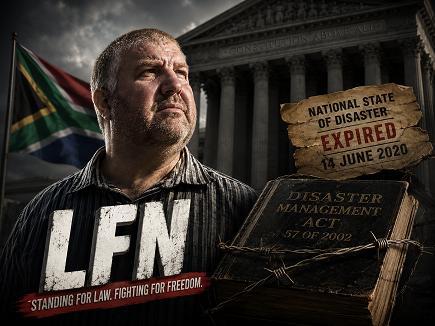
Excerpt: LFN is now enrolling its constitutional challenge against the Minister of CoGTA for hearing on the opposed motion roll in the High Court, Pretoria. At the centre of the case is a serious question: did South Africa’s National State of Disaster legally lapse on 14 June 2020, and were millions thereafter subjected to lockdown measures under powers that no longer lawfully existed? The matter now also raises disputes over missing documents, procedural irregularities, and constitutional accountability that could have far-reaching consequences for the South African public.

If you like our work, why not consider a donation or gift of your choice?
or make a quick donation… MobiPaid
The Liberty Fighters Network is now enrolling its challenge against the Minister of Cooperative Governance and Traditional Affairs for hearing on the opposed motion roll.
This case matters because millions of South Africans were restricted, punished, financially damaged, dismissed, prevented from working, prevented from trading, and forced to obey lockdown measures under a National State of Disaster which LFN says may already have legally lapsed on 14 June 2020.
In other words, this case asks a brutally simple question:
Did the State continue exercising disaster powers after those powers had already expired?
If the answer is yes, then South Africa is not dealing with a small administrative mistake. We are dealing with one of the most serious constitutional accountability questions arising from the lockdown period.
LFN’s case is that the National State of Disaster declared on 15 March 2020 lapsed by operation of law on 14 June 2020, and that the purported extension published on 05 June 2020, which sought to extend it “until 15 July 2020”, did not comply with section 27(5)(c) of the Disaster Management Act. The relief sought includes declarations that the National State of Disaster lapsed, that later extensions were invalid, and that measures flowing from those extensions must be dealt with in terms of just and equitable constitutional relief.
That is why LFN is also asking the Court to open a lawful pathway for those who suffered losses, including through possible class action certification or, alternatively, a special compensation scheme for legitimate claims arising from the invalid extensions.
Why Your Support Matters
This is not a comfortable case for the State.
If LFN succeeds, the consequences may reach far beyond one Minister, one Gazette, or one courtroom. It may create a foundation for people who suffered under unlawful lockdown extensions to seek proper legal redress.
That is why public support is not a side issue. It is part of the fight itself.
LFN does not run on political money, corporate retainers, or government funding. We do this work for free, in the public interest, and on behalf of ordinary people who are usually priced out of constitutional justice. Every court bundle, filing, trip, printing exercise, consultation, server payment, and day of preparation has to be carried somehow.
Supporting LFN is not charity. It is participation in constitutional accountability.
If South Africans want someone in court asking whether government obeyed the law during lockdown, then that work must be kept alive by the very public it seeks to protect.
The Minister’s Answer: Attack the Messenger, Avoid the Main Question?
The Minister has delivered what purports to be an answering affidavit.
Instead of squarely answering the core issue, namely whether the National State of Disaster lawfully survived beyond 14 June 2020, the Minister raises several preliminary attacks. These include arguments about delay, lis pendens, res judicata, standing, LFN’s authority, representation, alleged vexatiousness, and whether the matter is truly public-interest litigation.
LFN’s position is that these attacks do not answer the real legal question.
The question is not whether the State thought lockdown was useful. The question is not whether officials believed they were acting for public health. The question is not whether the Minister dislikes LFN or Reyno De Beer.
The question is whether public power was exercised within the limits of the law.
During the lockdown years, the State demanded strict obedience from the public. LFN now says the State must show that it was equally obedient to the law that gave it those powers.
The Defective Affidavit Issue
LFN has also delivered a Rule 30A(1) notice. This notice raises a serious procedural issue: the Minister’s purported answering affidavit allegedly does not comply with the mandatory requirements for affidavits and commissioning, because the deponent’s gender is not disclosed in the body of the affidavit and the commissioner of oaths also failed to identify and certify the deponent’s gender in the certification clause.
LFN’s position is that this renders the purported answering affidavit irregular, defective, and liable to be treated as pro non scripto, meaning as if it is not properly before Court.
The Minister has informed LFN that he has no problem with the commissioning and will not correct anything.
That means the Court may now have to decide whether the Minister’s answering affidavit is properly before it at all.
The Missing Documents Problem
LFN also delivered a Rule 35(12) notice requiring the Minister to produce documents and recordings referred to in the purported answering affidavit.
This is where things become even more interesting.
The Minister refers to material documents, scientific advice, epidemiological data, public health risk assessments, Ministerial Advisory Committee advice, internal memoranda, reports, approvals, recommendations, and documents allegedly proving that each extension followed the prescribed legal process. LFN asked for these documents to be produced.
The Minister failed to comply.
The consequence is serious: if a party fails to comply with Rule 35(12), that party may not, save with the leave of the Court, use the document or recording in the proceedings.
In ordinary language:
If the Minister wants to rely on documents to justify lockdown extensions, he must produce them. If he refuses to produce them, he should not be allowed to rely on them later.
That is not legal gamesmanship. That is basic fairness.
The Bigger Picture
The lockdown years were not theoretical. They were lived.
Businesses collapsed. Families lost income. People were dismissed. Many were pressured into medical decisions they did not want to make. Movement was restricted. Trade was restricted. Religious, family, social, economic, and personal freedoms were curtailed.
The State cannot simply say, years later, “It was a difficult time”, and expect the Constitution to look away.
Crisis does not suspend legality. Fear does not amend legislation. Good intentions do not cure unlawful conduct.
This case is about whether South Africa is governed by law or by executive convenience.
What Happens Next?
LFN is now moving the matter toward a hearing date on the opposed motion roll.
The Minister will have the resources of the State. The Minister will have lawyers. The Minister will have public funds behind him.
LFN has its members, supporters, and the public who understand that constitutional accountability does not happen by itself.
If you believe this case matters, support the work. Share the article. Speak about the issue. Help LFN keep the doors open, the papers filed, and the fight alive.
The lockdown years must still answer to the law.
And LFN intends to make sure they do.

If you like our work, why not consider a donation or gift of your choice?
or make a quick donation… MobiPaid


Leave a Comment
You must be logged in to post a comment.