
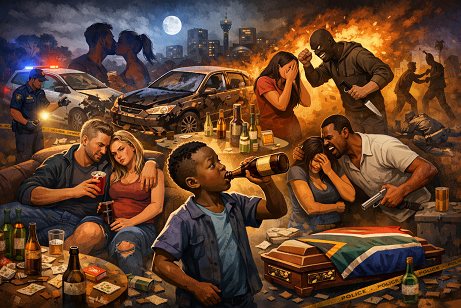
Excerpt: On a short drive along the N1 from Acasia to Midrand, my family and I encountered two separate intoxicated drivers — late morning, on a busy highway, still drinking while driving. That moment, together with recent revelations about South Africa’s R25 billion illicit alcohol underworld, forced a hard reckoning. This is not an abstract debate about “responsible drinking”. It is a confrontational call to South Africans to reconsider alcohol’s role in our crime, violence, family breakdown, moral erosion, and even our ability to resist corruption — starting now, at the beginning of the year.

If you like our work, why not consider a donation or gift of your choice?
or make Quick donation… MobiPaid
I did not wake up one morning deciding to write this article.
This article was forced out of me.
What Happened on the N1
On Saturday late morning, my family and I were travelling on the N1 highway, from Acasia to Midrand — not a too long drive at all.
Yet within that short stretch, we encountered two separate incidents, involving two different bakkies, at different points along the route.
These vehicles were not driving together.
They were two unrelated incidents, which in many ways makes the reality far more disturbing.
In both cases, the drivers — fellow white men, and I emphasise this deliberately because honesty matters more than political comfort — were clearly intoxicated.
Both vehicles were swirling across lanes, nearly colliding with other motorists. The driving was not momentary negligence — it was sustained, reckless endangerment.
In at least one of the incidents, the driver appeared to be actively drinking what looked like beer while driving.
This was not at night.
This was not after a rugby match or a festival.
This was late morning, on a major national highway, while families were on the road.
And in that moment, a familiar and deeply unsettling thought struck me:
If either of those drivers had killed someone that morning, it would have been reported as a “tragic accident”.
Not what it really was — alcohol-enabled endangerment.
No alcohol producer would be named.
No cultural self-reflection would follow.
And by the next weekend, the same thing would happen again.
Why I Am Writing This Now
Shortly after that incident, I read the IOL investigative article titled:
“The killer in your glass: Inside South Africa’s R25bn alcohol underworld”
And it confirmed what many of us already know but prefer not to confront.
South Africa does not merely have problem drinkers.
South Africa has a systemic alcohol dependency problem.
When nearly one-fifth of all alcohol consumed in the country is illegal,
When the illicit alcohol trade is worth over R25 billion,
When legal and illegal markets bleed into one another,
And when consumption patterns remain extreme —
You are no longer dealing with casual use.
You are dealing with functional alcoholism at a societal scale.
That article raised red flags for me not because it shocked me, but because it confirmed the intensity and reach of an industry that thrives on denial, while the consequences are borne by families, children, and communities.
The Cultural Normalisation of Drunkenness
In South Africa, alcohol is no longer merely a substance.
It has become a cultural identity.
I am considered strange when I attend a braai and do not drink.
I am mocked when I choose sobriety.
I am treated with suspicion when I say I do not consume alcohol at all.
We have reached a point where:
- People brag about how drunk they got,
- Vomiting, blackouts, and lost memories are laughed off,
- Reckless behaviour is retold as comedy rather than shame.
Sobriety now requires justification.
Drunkenness does not.
That alone should disturb every thinking person.
Children Are Being Groomed Into Alcohol
South African children are not merely exposed to alcohol — they are actively inducted into it.
By parents.
By family members.
By trusted adults.
It starts with:
- “Just a sip.”
- “Don’t be silly.”
- “It won’t hurt you.”
By their teenage years, alcohol is already normalised as a rite of passage. Young people can’t wait to go on “jolls” — not to build relationships, but to get drunk.
And what follows is predictable:
- Unprotected sex,
- Unplanned pregnancies,
- Abortions,
- Sexual regret,
- Sexual violence,
- Trauma everyone wants to forget the next morning.
All of it sanitised under the phrase “having fun”.
Alcohol Syndrome: Damage Passed to the Next Generation
There is a consequence of alcohol consumption that South Africa barely wants to talk about: alcohol syndrome cases.
Children born with permanent neurological and developmental damage — not through fate, but through alcohol use by their mothers during pregnancy.
These children often:
- Struggle academically,
- Battle impulse control,
- Drop out of school,
- Become more vulnerable to crime and addiction later in life.
Alcohol syndrome is not a medical abstraction.
It is avoidable suffering, quietly transferred from one generation to the next, because confronting it would require confronting alcohol itself.
The Great Statistical Lie About Alcohol
Here is where intellectual honesty matters.
You will often hear claims such as:
- “About half of domestic violence cases involve alcohol.”
- “A portion of violent crime is alcohol-related.”
And many people draw a dangerously false conclusion:
“So the rest must be sober violence.”
That conclusion is wrong.
Alcohol statistics only count:
- Measured intoxication,
- Admissions of drinking,
- Explicit recording by police or hospitals.
They do not count:
- Long-term alcohol dependency shaping behaviour,
- Alcohol-fuelled unemployment and poverty,
- Chronic relationship breakdown,
- Learned violence in alcoholic households,
- Withdrawal-related aggression,
- Intergenerational trauma.
Alcohol is often not present at the moment of violence — but it is deeply present in the conditions that make violence likely.
So when statistics say “half”, the honest interpretation is:
At least half — and likely far more.
Alcohol’s role is not exaggerated.
It is systematically minimised.
Violence Is Not a Gender-Exclusive Reality
Another uncomfortable truth must be stated plainly.
Violence in relationships is not a male-only phenomenon.
Yes, women suffer enormously.
Yes, women deserve protection.
But studies have repeatedly shown that:
- Men under-report domestic abuse far more than women,
- Alcohol-fuelled aggression occurs across genders,
- Emotional, psychological, and physical abuse by women is significantly under-acknowledged.
Alcohol does not discriminate.
It erodes restraint in everyone.
Framing alcohol-fuelled violence as a one-directional issue is dishonest and prevents honest solutions.
The COVID-19 Lockdown: The Experiment Nobody Wants to Remember
I did not support the COVID-19 narrative and lockdown.
But honesty demands this be said:
When alcohol sales were banned:
- Trauma admissions collapsed,
- Violent crime dropped,
- Emergency wards became quiet.
That was not ideology.
That was observable reality.
For a brief period, South Africa saw what it looks like without alcohol-fuelled chaos. Regrettably, due to the “plandemic“, as many would say.
Instead of learning from it, we rushed back to denial the moment alcohol returned.
A Sober Society Is Harder to Control
I have increasingly come to the view — and I say this as an opinion formed through observation, not conspiracy — that a heavily drinking population is politically convenient.
A society that numbs itself every weekend is far less likely to organise, question, or resist corruption rationally.
Alcohol dulls not only pain, but clarity, discipline, and courage.
Instead of confronting injustice soberly and persistently, people are encouraged to escape it temporarily, only to wake up fatigued, disengaged, and emotionally blunted.
A sober population thinks sharper, remembers longer, and demands more accountability.
A drunk population forgets, deflects, and complies.
If South Africans were to meaningfully reduce their alcohol consumption, I am convinced it would not only reduce crime and domestic conflict, but also strengthen our collective ability to challenge corruption and abuse of power — precisely because sobriety restores agency, conscience, and resolve. Perhaps that is why there is so little real urgency to confront alcohol properly at a systemic level.
The Alcohol Industry and the Illicit Market
We are told the illegal alcohol trade is driven by criminals alone.
Perhaps.
But South Africans have seen this pattern before.
In the mining sector, zama-zama operations were exposed as being quietly enabled by legal interests who benefited while publicly condemning them.
The entire Capitalist system, many of us embrace as gospel, is built on crime and deceit. A certain crime has to exist for the producers or service providers to actually be the ones receiving the remuneration and benefits.
It would be naïve to assume the alcohol industry is immune to similar dynamics.
When:
- Taxes rise,
- Regulations tighten,
- Restrictions are imposed,
Illicit supply mysteriously expands.
At the very least, this demands scrutiny, not silence.
Liberty Fighters Network exists precisely because systems of power resist scrutiny.
Alcohol and Moral Erosion
Alcohol does not only break bodies.
It erodes morals.
Boundaries collapse.
Accountability disappears.
Sexual misconduct is excused as “being drunk”.
Violence becomes “losing control”.
Filth and degradation are laughed off.
And the next morning, everyone pretends nothing happened.
That is not freedom.
That is addiction disguised as culture.
A Direct Challenge at the Start of the Year
I am writing this at the beginning of the year, deliberately.
Not later.
Not when it’s convenient.
Not when resolutions are forgotten.
If you are serious about:
- Reducing crime,
- Protecting children,
- Restoring families,
- Addressing violence honestly,
Then start here:
Reconsider your alcohol consumption now.
Not “someday”.
Not “in moderation”.
Not “after the next braai”.
Now.
Final Word to LFN Supporters
Liberty Fighters Network does not exist to make people comfortable.
It exists to confront truths that systems, industries, and cultures would rather ignore.
Alcohol is not neutral.
It is not harmless.
And it is not merely “abused by a few”.
It is structurally embedded in South Africa’s social decay.
You do not have to agree with me.
But you should be honest enough to ask yourself:
What has alcohol really added to my life — and what has it taken from this country?
If this article unsettles you, that is the point.
Real reform never begins with comfort.

Kindly consider supporting our work by giving a donation or gift of your choice.
2 responses to “LFN Takes Aim at SA’s Alcohol Epidemic”
-
I am in agreement with most that has been written here. I have witnessed the toxic relationship we have with alcohol. One question – why are you mentioning the illicit market for alcohol? The problem is alcohol, so both legit and illicit markets are part of that. With a ZAR25bn potential, I see nothing strange about all manner scum moving into that space. Why is it necessary to differentiate between legit and illicit?
-
You are totally correct. The reason I have mentioned it confirms how massive the market is, and that the “legal” producers even dare to fight against the so-called “illegal” producers. It’s clearly an immoral and unethical industry, and there should not even be any differentiation between “legal” and “illegal” producers. All alcohol producers have blood on their hands.
-


Leave a Comment
You must be logged in to post a comment.