
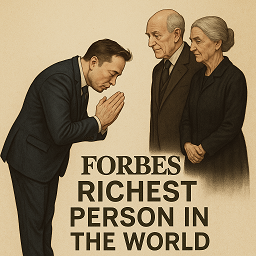
Excerpt: Each year, the world turns to the Forbes Rich List as if it were sacred scripture — but beneath the glitter lies a carefully crafted illusion. Participation is voluntary, valuations are speculative, and some of the wealthiest families on Earth are nowhere to be seen. What we’re really witnessing is not a reflection of global wealth, but a spectacle of status, curated for entertainment, profit, and control. It’s time to ask: who decides what counts as ‘rich’ — and why does it matter?
If you like our work, why not consider a donation of your choice?
Every year, without fail, the global public is met with the release of the Forbes List of the Richest People in the World, and every year, millions of readers are drawn into this showcase of monetary might. It is published with an air of finality — as if it is the absolute truth of who holds power and influence over the world’s resources. But should we, the people, simply accept it as gospel? Or is it time to scrutinise the motives behind this highly publicised spectacle?
A Brief History of the Forbes List
The idea of ranking the world’s billionaires was popularised by Forbes magazine in 1987, when it first released its now-famous “World’s Billionaires List.” What started as a niche feature has since grown into one of Forbes’ most viewed and talked-about releases annually — turning billionaires into household names and even celebrities in their own right.
The methodology behind the list is presented as rigorous and data-driven. As reported by Forbes itself, each year a dedicated team of roughly 50 journalists spread across the globe participates in this exercise. They are given a preliminary list of known high-net-worth individuals — sourced from financial disclosures, previous lists, public trading data, and company valuations. From there, the journalists reach out independently to these individuals or their representatives.
The public is led to believe that these interactions are meant to ensure transparency: each person is given the opportunity to submit audited financial documents, clarify the structure of their holdings, and declare their assets and liabilities. However, participation is entirely voluntary, and much of the wealth that is not easily trackable — such as privately held companies, offshore trusts, or family office assets — is either estimated or entirely excluded.
This process sounds objective on the surface, but in practice, it is highly discretionary. Forbes itself admits that many valuations rely on best estimates, market sentiment, and third-party intelligence. Some people are very eager to make the list — it boosts their profile and public standing — while others, particularly those whose wealth is rooted in dynastic or intergenerational structures, deliberately remain off the radar.
A Manufactured Competition of Status
At Liberty Fighters Network (LFN), we believe that this so-called “list” has long since lost any claim to objectivity or authenticity. It has become, for all intents and purposes, a commercialised competition, where the objective seems less about reflecting truth, and more about status projection — a yearly leaderboard for the ultra-wealthy who choose to participate.
Critically, it is clear that inclusion is voluntary in nature, even if not officially admitted. Individuals or families with enormous wealth can quite easily choose not to declare the full extent of their assets — and many likely do. Think of the Rothschild family, whose wealth, power, and reach are historically uncontested, yet they remain curiously absent from the list. Is that because their wealth does not qualify them? Unlikely. It is more believable that their choice not to participate, and to stay below the radar, reflects a level of discretion that those such as Elon Musk, who seemingly embraces the limelight, do not opt for.
This raises a fundamental question: who really decides who gets on the list? And what are the criteria? Forbes presents the data as if scientifically verified, but closer inspection reveals that entire industries of wealth are left out, or understated, particularly those involving private wealth, inherited empires, and shadow finance.
More Than a List — A Narrative
The public, unfortunately, takes the list as a verified truth, not realising that it is essentially a narrative, designed and curated for political, economic, and entertainment value. The way it is presented influences markets, strengthens capitalist ideology, and directs public admiration toward selected individuals, while ignoring the true nature of global wealth distribution.
Moreover, this list feeds into an illusory hierarchy of power — reinforcing the idea that the richest person on paper somehow wields the most influence. It is a myth of meritocracy, cleverly woven into the fabric of modern media, that success and wealth are naturally deserved and transparently earned. But those of us who see behind the curtain understand that power is often hidden, untraceable, and deliberately kept away from public scrutiny.
Who Benefits?
Let us not forget — Forbes profits immensely from the production and marketing of this list. Its viewership spikes, its advertising revenue increases, and its brand enjoys a level of relevance that borders on celebrity status itself. It is in their financial interest to keep the list controversial, sensational, and — above all — subjective. There is no independent auditing mechanism to confirm the fairness or truthfulness of the information. And in a world where media houses often bow to external pressures, can we honestly believe that the list remains untouched by corporate or political influence?
In truth, this list creates nothing of value for ordinary people. It adds no meaning to our lives, improves no livelihoods, and reveals no justice. Instead, it quietly upholds an elite-driven value system, reminding us of our place in the societal food chain.
Final Thought
We must approach such lists — and the messaging they convey — with caution. Not because we envy the rich, but because we understand the role that such narratives play in shaping our worldviews, suppressing critical thought, and misleading the masses.
Let us remember: True wealth has never been found in magazines.
Kindly consider supporting our work by giving a donation of your choice.

